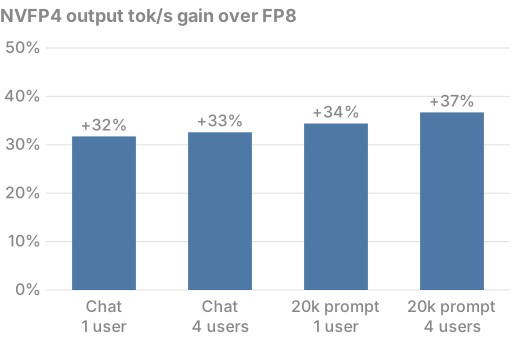
On one RTX PRO 6000 with SGLang and DFlash2 speculative decoding, NVFP4 is 32–37% faster than FP8 for stock Qwen3.8-27B, on short chat and on 20k-token prompts. BFCL tool calling stays within noise (174 vs 167 of 205).
Results
Stock Qwen3.8-27B: Qwen/Qwen3.8-27B-FP8 vs RadixArk/Qwen3.8-27B-NVFP4.
| Scenario | FP8 | NVFP4 | Δ |
|---|---|---|---|
| Chat, 1 user, out tok/s | 133.8 | 176.3 | +32% |
| Chat, 4 users, out tok/s | 449.9 | 596.5 | +33% |
| 20k prompt, 1 user, out tok/s | 73.3 | 98.5 | +34% |
| 20k prompt, 4 users, out tok/s | 104.1 | 142.3 | +37% |
| 20k prompt, 1 user, TTFT p50 | 3.20 s | 2.34 s | −27% |
| 20k prompt, 4 users, TTFT p50 | 8.48 s | 5.78 s | −32% |
| DFlash2 accept length, chat 1 user | 3.49 | 3.41 | −2% |
| BFCL subset, correct | 167/205 | 174/205 | +7 |
| BFCL mean latency per call | 1.22 s | 0.92 s | −25% |
Takeaways
- The gain holds with a 20k-token prompt. Time to first token drops 27–32%, so prefill gets faster as well as decode.
- DFlash2 acceptance barely moves (accept length 3.49 vs 3.41), so the gain comes from the target model, not the drafter. Median time per output token in chat at 1 user drops from 7.30 ms to 5.59 ms.
- BFCL shows no measurable change. Most of the +7 is
irrelevance(12 → 18) andmulti_turn_base(14 → 16), categories of 20 cases each.
BFCL by category
| Category | FP8 | NVFP4 |
|---|---|---|
| simple_python | 25/25 | 25/25 |
| multiple | 24/25 | 23/25 |
| parallel | 18/20 | 18/20 |
| parallel_multiple | 19/20 | 19/20 |
| live_simple | 18/20 | 18/20 |
| live_multiple | 20/25 | 19/25 |
| multi_turn_base | 14/20 | 16/20 |
| multi_turn_miss_param | 3/10 | 4/10 |
| irrelevance | 12/20 | 18/20 |
| live_irrelevance | 14/20 | 14/20 |
| Total | 167 | 174 |
Setup
Hardware and system:
- GPU: NVIDIA RTX PRO 6000 Blackwell Workstation Edition, 96 GB. PCIe Gen 4 x16 (the card supports Gen 5;
nvidia-smireports Gen 4 as this system’s maximum). Power limit 400 W, set at boot (default 600 W). Idle during runs, one config at a time. - CPU: AMD Ryzen 9 7950X (16 cores, 32 threads).
- RAM: DDR5, 250 GiB usable.
- Board: Gigabyte B650 AORUS ELITE AX.
- Models on a Crucial P3 Plus 4 TB NVMe (ext4 on LUKS).
- OS: Ubuntu 24.04.2, kernel 6.8.0-147, NVIDIA driver 580.178.04 (CUDA 13.0), rootless Docker 28.0.4, NVIDIA Container Toolkit 1.18.1.
Serving stack:
- Image:
lmsysorg/sglang:nightly-dev-cu13-20261010-961bcf48. - Checkpoints:
Qwen/Qwen3.8-27B-FP8@017b9c7a,RadixArk/Qwen3.8-27B-NVFP4@319f741c. - Speculative decoding: DFlash2 (
z-lab/Qwen3.8-27B-DFlash2), 8 draft tokens, for every run. --mem-fraction-static0.50 for FP8, 0.41 for NVFP4, so both get about the same KV pool (240,512 vs 236,864 tokens, 28 mamba slots each).- Requests use
reasoning_effort=medium.
Launch flags:
python3 -m sglang.launch_server --model-path <checkpoint>
  --mem-fraction-static <0.50|0.41> --max-running-requests 4 --context-length 153600
  --dtype auto --attention-backend flashinfer
  --reasoning-parser qwen3 --tool-call-parser qwen3_coder
  --speculative-algorithm DFLASH --speculative-draft-model-path <DFlash2>
  --speculative-num-draft-tokens 8
  --mamba-full-memory-ratio 0.9 --mamba-ssm-dtype bfloat16
  --mamba-radix-cache-strategy extra_buffer_lazy
  --chunked-prefill-size 2048 --page-size 64
  --enable-hierarchical-cache --hicache-size 64 --hicache-write-policy write_through
  --kv-cache-dtype fp8_e4m3 --schedule-policy lpm --enable-session-radix-cache
  --sleep-on-idle --trust-remote-code
Serving: python3 -m sglang.benchmark.serving --backend sglang-oai-chat --flush-cache --warmup-requests 2 --seed 1.
- Chat: ShareGPT prompts, 1024 output tokens; 12 prompts at 1 user, 32 at 4 users.
- 20k prompt: random 20,000-token input, 512 output tokens; 4 prompts at 1 user, 8 at 4 users.
BFCL: bfcl-eval 2026.3.23, the Qwen/Qwen3-32B-FC handler, a fixed 205-case subset across 10 categories (case ids).
Caveats
- One run per config. Categories have 10–25 cases, so a few points either way is noise.
- The GPU ran at a 400 W power limit, not the default 600 W. I haven’t measured either format at 600 W.
- Output lengths are fixed (
ignore_eos), so tok/s compares speed only, not how much each model thinks. - BFCL uses its own Qwen3 FC prompt, not the model’s chat template. Compare these scores with each other, not with the public leaderboard.
- Deep-AI-Evo measured a smaller gap on the same card with vLLM 0.21 and
unsloth/Qwen3.8-27B-NVFP4: 50.9 → 56.4 tok/s without MTP, 115.8 → 132.3 with MTP k=2, single stream (repo). The engine, checkpoint and speculative decoding all differ from mine, and I haven’t tested which of them explains the difference.
Raw data
- Scripts, configs and raw results: adcostanza/benchmarks.
run.shthere reruns both configs. - Serving results (one JSON line per scenario, including full server args): FP8, NVFP4.
- BFCL scores and every model response:
results/<label>/bfcl/in the same folder.