On one RTX PRO 6000 with SGLang, DFlash2 with 8 draft tokens is the fastest drafter for stock Qwen3.8-27B NVFP4 in every scenario I ran, from short chat to a 120k-token prompt. It beats the model’s own MTP head at 3 and 7 steps, DFlash2 with 4 draft tokens, and RadixArk’s DSpark. Tool calling (BFCL) doesn’t move.
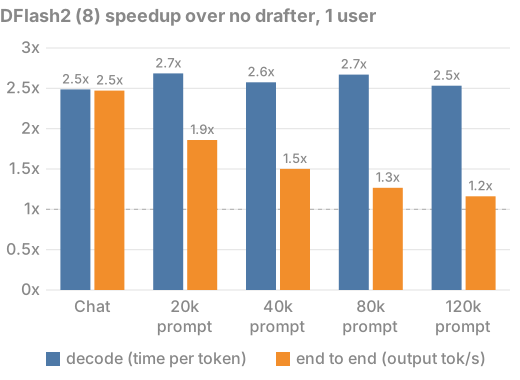
The end-to-end gain drops from 2.5x on chat to 1.16x at 120k. That’s prefill, not the drafter: time per output token stays about 2.5x faster at every length.
Results
Output tok/s, one run per config. Bold is the fastest.
| Scenario | No drafter | MTP 3 | MTP 7 | DFlash2 4 | DFlash2 8 | DSpark |
|---|---|---|---|---|---|---|
| Chat, 1 user | 72.0 | 143.8 | 143.0 | 143.3 | 178.0 | 148.1 |
| Chat, 4 users | 233.7 | 522.0 | 506.5 | 489.5 | 592.5 | 503.8 |
| 20k prompt, 1 user | 52.9 | 85.1 | 84.3 | 84.9 | 98.4 | 88.8 |
| 20k prompt, 4 users | 94.7 | 129.9 | 127.9 | 131.5 | 137.5 | 131.2 |
| 40k prompt, 1 user | 39.1 | 52.9 | 55.0 | 54.5 | 58.7 | 56.9 |
| 80k prompt, 1 user | 22.5 | 26.4 | 26.8 | 27.1 | 28.5 | 27.5 |
| 120k prompt, 1 user | 14.2 | 15.3 | 15.4 | 15.9 | 16.5 | 15.9 |
| BFCL subset, correct of 205 | 171 | 173 | 173 | 176 | 176 | 171 |
Mean accept length (tokens per verify step, 1 user):
| Config | Chat | 20k | 40k | 80k | 120k |
|---|---|---|---|---|---|
| MTP 3 | 2.80 | 2.87 | 2.74 | 2.90 | 2.84 |
| MTP 7 | 3.36 | 3.41 | 3.65 | 3.79 | 3.55 |
| DFlash2 4 | 2.81 | 2.79 | 2.76 | 2.70 | 2.66 |
| DFlash2 8 | 3.43 | 3.54 | 3.28 | 3.43 | 3.46 |
| DSpark | 2.84 | 2.95 | 3.07 | 2.88 | 2.70 |
Takeaways
- Acceptance doesn’t fall with context. No drafter shows a trend from chat to 120k, only swings of 0.1–0.3. Median time per output token for DFlash2 8 is 5.4–6.5 ms against 13.9–16.5 ms without a drafter, i.e. 2.5–2.7x faster at every length.
- So why does the gain shrink? Because these requests are 512 output tokens behind a long prompt. At 120k, prefill takes 27.8 s and the 512 tokens take about 3.3 s. The drafter only speeds up the 3.3 s. Output tok/s is total output over wall time, so prefill eats the gain. With longer answers the end-to-end number would sit closer to the decode number.
- More accepted tokens isn’t faster. MTP 7 accepts more per step than DFlash2 8 at 40k and 80k (3.65 and 3.79 vs 3.28 and 3.43) and is still slower everywhere, because each MTP step costs more (6.9–8.3 ms per token at 1 user vs 5.4–6.5).
- DSpark doesn’t beat DFlash2 4 here. It accepts about as many tokens as MTP 3. It also has the slowest BFCL calls of all six configs, slower than no drafter (3.24 s mean vs 2.53 s; DFlash2 8: 0.91 s). I haven’t looked into why.
DFlash2 with 8 draft tokens is what I run day to day, and nothing here changes that.
The drafter costs KV cache
Same --mem-fraction-static 0.41 for every config. The draft model and verify buffers come out of the same budget:
| Config | KV pool (tokens) | Mamba slots |
|---|---|---|
| No drafter | 318,592 | 117 |
| MTP 3 | 276,224 | 39 |
| MTP 7 | 264,256 | 24 |
| DFlash2 4 | 244,160 | 44 |
| DFlash2 8 | 236,864 | 28 |
| DSpark | 241,216 | 28 |
DFlash2 8 gives up 26% of the KV pool and 76% of the mamba slots (max_total_num_tokens and mamba_cache_size from each server.log). With 4 running requests and a 153,600-token context that’s still enough for every scenario above. I haven’t measured what it costs in multi-turn prefix cache hits.
Is the low accept length a thinking or sampling artifact?
The DFlash2 card reports 4.10 on MT-Bench with 7 draft tokens (H200, xhigh reasoning). I get 3.43 on ShareGPT at medium. So I reran DFlash2 8 with thinking off and with temperature 0:
| Scenario | DFlash2 8 | Thinking off | Temperature 0 |
|---|---|---|---|
| Chat, 1 user, out tok/s | 178.0 | 184.7 | 177.2 |
| Chat, 4 users, out tok/s | 592.5 | 566.0 | 593.2 |
| 20k prompt, 1 user, out tok/s | 98.4 | 101.2 | 98.5 |
| 20k prompt, 4 users, out tok/s | 137.5 | 140.0 | 138.5 |
| Chat, 1 user, accept length | 3.43 | 3.57 | 3.41 |
Neither one closes the gap. The prompts (ShareGPT vs MT-Bench) and the hardware differ, so the card’s number isn’t a target I should expect to hit.
Setup
Hardware: same machine as the NVFP4 vs FP8 post. RTX PRO 6000 Blackwell 96 GB at a 400 W power limit, Ryzen 9 7950X, 250 GiB DDR5, Ubuntu 24.04.2, driver 580.178.04, rootless Docker. Full list in hardware.md.
Serving stack:
- Image:
lmsysorg/sglang:nightly-dev-cu13-20261010-961bcf48for every config (it has bothDFLASHandDSPARK). - Target:
RadixArk/Qwen3.8-27B-NVFP4@319f741c. - Drafters:
z-lab/Qwen3.8-27B-DFlash2@50307d4c,RadixArk/Qwen3.8-27B-DSpark@b9a5dbdf(DSpark v2). MTP uses the head built into the target checkpoint. - Requests use
reasoning_effort=medium.
Shared flags, the same as the first post:
python3 -m sglang.launch_server --model-path <checkpoint>
  --mem-fraction-static 0.41 --max-running-requests 4 --context-length 153600
  --dtype auto --attention-backend flashinfer
  --reasoning-parser qwen3 --tool-call-parser qwen3_coder
  --mamba-full-memory-ratio 0.9 --mamba-ssm-dtype bfloat16
  --mamba-radix-cache-strategy extra_buffer_lazy
  --chunked-prefill-size 2048 --page-size 64
  --enable-hierarchical-cache --hicache-size 64 --hicache-write-policy write_through
  --kv-cache-dtype fp8_e4m3 --schedule-policy lpm --enable-session-radix-cache
  --sleep-on-idle --trust-remote-code
Then the speculative flags, appended after the shared ones:
| Config | Flags |
|---|---|
| MTP 3 | --speculative-algorithm EAGLE --speculative-num-steps 3 --speculative-eagle-topk 1 --speculative-num-draft-tokens 4 |
| MTP 7 | same with --speculative-num-steps 7 --speculative-num-draft-tokens 8 |
| DFlash2 4 | --speculative-algorithm DFLASH --speculative-draft-model-path <DFlash2> --speculative-num-draft-tokens 4 |
| DFlash2 8 | same with --speculative-num-draft-tokens 8 |
| DSpark | --speculative-algorithm DSPARK --speculative-draft-model-path <DSpark> --speculative-draft-model-quantization unquant --speculative-draft-attention-backend flashinfer --speculative-dspark-block-size 7 --speculative-num-steps 1 --speculative-eagle-topk 1 |
Serving: python3 -m sglang.benchmark.serving --backend sglang-oai-chat --flush-cache --warmup-requests 2 --seed 1.
- Chat: ShareGPT prompts, 1024 output tokens; 12 prompts at 1 user, 32 at 4 users.
- 20k prompt: random 20,000-token input, 512 output tokens; 4 prompts at 1 user, 8 at 4 users.
- 40k, 80k, 120k prompt: random input, 512 output tokens, 4 prompts at 1 user.
BFCL: bfcl-eval 2026.3.23, the Qwen/Qwen3-32B-FC handler, the same fixed 205-case subset as the first post (case ids).
Caveats
- One run per config. The 40k–120k scenarios have 4 prompts each, so their rates carry a few percent of noise. BFCL categories have 10–25 cases, so 171 vs 176 is noise.
- DSpark runs on the shared flags so only the drafter changes. Its model card serves it with float32 mamba state,
--mamba-radix-cache-strategy extra_buffer,--mamba-full-memory-ratio 11.93and 32k prefill chunks. With those it might do better than here. - 400 W power limit, not the default 600 W.
- Output lengths are fixed (
ignore_eos), so this measures speed only. - Deep-AI-Evo found MTP slower than no MTP at long context on the same card: 18.2 vs 43.7 tok/s decode at ~177k tokens, NVFP4, MTP k=2 (repo). I don’t see that up to 120k: MTP 3 keeps decode at 8.5 ms per token vs 16.5 without a drafter. Their stack is vLLM (0.21 and 0.26) with
unsloth/Qwen3.8-27B-NVFP4, and I stopped at 120k, so this doesn’t contradict them.
Raw data
- Scripts, configs and raw results: adcostanza/benchmarks.
run.shreruns every config, about two hours. results/<label>/per config:bench-serving.jsonl(one line per scenario, full server args included),server.log, andbfcl/with every model response.